
Table of Contents
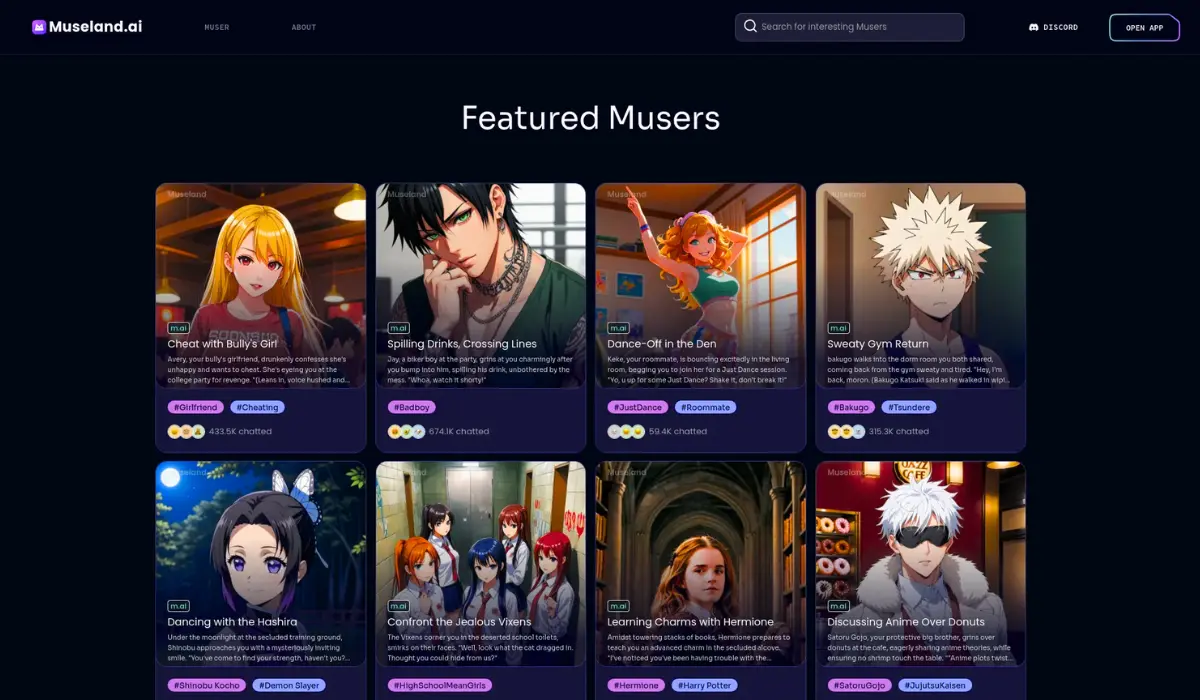
Museland AI was a favorite for many people who loved creating characters and roleplaying. So when it shut down in 2025, many people ended up searching for something that was creative and enjoyable.
If you are one of them, you are probably wondering which platform comes closest to what Museland AI offered. The good news is that there are several amazing alternatives now, some completely free, others with optional upgrades.
In this guide, I will discuss the best Museland AI alternatives that actually deliver a similar experience and help you keep your stories and characters alive.
What Is Museland AI, and Why Do Users Look for Alternatives
Museland AI is a highly creative app. It also leverages artificial intelligence to create content, from music and lyrics to multimedia ideas, along with the compositions.
It is made to assist the artists, writers, and creators to brainstorm and also to produce the work quickly by offering AI-driven inspiration and automated generation tools.
Although users might also look forward to the alternatives just because of the:
- The Feature limitations: Free or the lower-tier plans might also restrict access to the advanced generators or to the high-quality outputs.
- Performance errors: Generation speed or the responsiveness might also lag, specifically in the time of high-demand periods.
- Quality concerns: The AI-generated content might also lack depth, originality, or coherence as compared to the other tools, prompting the creators to examine the platforms with further robust models or with further customization.
Hidden Problems With Museland AI That Users Should Know
In the times when the Museland AI provides a helpful starting point for creative ideation, there are multiple drawbacks that do not always get mentioned at the front:
1. The Inconsistent Output
The quality of the AI-generated ideas or the quality of the compositions can vary significantly from session to session.
Therefore, sometimes the results may also feel polished as well as very coherent. Other times, they might be generic, or they might be off the mark.
2. Restricted Creative Control
The users often do not get enough flexibility to direct or fine-tune the output of the AI. Adjusting tone, style, or the structure can be a little difficult, alongside the further detailed control presets are also restricted.
3. Long Generation Times
Well, depending on the server load or on the complexity of the prompt, the generation can take a little longer.
Waiting for the responses can interrupt the overall creative flow, specifically for the users who like to iterate rapidly.
4. The Unreliable Servers
There are intermittent reports of downtime or slowdowns, specifically on the free or the lower-tier plans. When servers are unreliable, users might not always be able to access the platform when they require it.
5. Daily Usage Caps
Most of the users are restricted by the day-to-day or the monthly usage limits. It depends on their subscription level.
These caps can severely restrict the productivity of creators working on larger projects or in the times of creative bursts.
You May Like This: Best Janitor AI Alternatives Free & Paid Expert Picks
Is Museland AI Free to Us?
Well, the Museland AI provides the free (premium) plan along with the day-to-day credits. In accordance with the user reports, the free tier offers about 25 credits each day.
Along with sync-free credits, you can utilize the basic features, such as simple chat interactions. But the multi-media-rich messages (images, voices, as well as scenes) consume further credits.
Due to the credit system, there is a day-to-day use cap; once you run out of credits, you are required to wait for the next reset or also recognize upgrading.
The paid plan (premium) also offers further credits each month (e.g., ~200 credits) alongside access to enhance the visuals with the voice options.
Does Museland AI Still Work?
Museland AI is not very reliable in operating as of 2025. Here is the detail about the recent situation, depending on the user reports as well as on the community discussion:
- Many users report that the Museland AI shut down around March 20, 2025.
On Reddit, users report that the servers are offline. Also, multiple users believe their data (chat history, as well as the characters) might be lost: - “Museland has shut down … all of the musers have been deleted.”
There is no confirmed, up-to-date communication from the team at the Museland. - Some users still remain hopeful, citing rumors about the “3 to 6 month” return while the team upgrades servers.
- “Apparently, they will be back in about three to six months just because they will be upgrading the servers.”
- According to the reports, the shutdown might be permanent, with financial issues along with the high operational costs cited as reasons.
- Some of the unofficial APK versions of Museland are circulating, but these are risky, since the backend servers are down, and even the working app file would not restore functionality.
Best Free Museland AI Alternatives
Here are the free (or freemium) AI tools that serve as great alternatives to Museland AI, specifically if you are utilizing it for creativity, image generation, or design.
Mini-reviews involve pros & cons, key features, alongside pricing notes when there is a paid option.
1. Canva AI
Canva’s Magic Studio brings generative AI to the familiar design tool: you can utilize text-to-image, Magic Edit, background removal, as well as more, all in the drag-and-drop design environment. It is ideal for creators who want to integrate AI visuals into presentations, social media graphics, and marketing assets.
Pros: It is very user-friendly; design + AI in one tool; a good variety of styles.
Cons: Free tier has limited AI credits, improved tools like the background remover or premium AI styles are locked behind Pro.
Key Features: Text-to-image generation, Magic Edit, Magic Eraser, Magic Expand, along with the design templates.
Price: Free plan available. Pro plan (for more AI credits as well as design features) starts around the US$15/month according to some sources.
2. Leonardo AI
Leonardo AI is a very powerful image-generation tool that utilizes a token system. The free tier gives daily tokens, which are enough to generate quite a few photos, making it very usable for hobbyists or for side creators.
Pros: Generous free tokens, great model variety, and the ability to train your own model in a paid plan.
Cons: Free users generate publicly (no private generations), and alongside high-quality or enhanced models, need to spend more tokens.
Key Features: Token-based generation, model training, upscaling, background removal, alongside multiple model types.
Price: Free tier (150 fast tokens/day). Paid plans: Apprentice (~$12/month), Artisan (~$30/month), and the Maestro (~$60/month).
3. Bing Image Creator
Microsoft’s free image generator (via Bing / Microsoft Designer) lets you make images from text prompts easily.
It is fully web-based as well as integrated with Microsoft’s ecosystem, making it very accessible without even downloading anything.
Pros: Totally free to utilize, no downloads, great for the quick concept art or simple image creation.
Cons: Quality with the style can be more limited as compared to the advanced AI art tools; credit or use limits might apply.
Key Features: Text-to-image conversion, simple UI, web integration, and fast generation.
Price: Free, utilizes a credit system according to some sources.
4. Pixlr AI
Pixlr combines robust photo editing with generative AI. It assists the text-to-image, inpainting (fill), background removal, alongside more, making it a very handy all-in-one creative suite in your browser.
Pros: It has rich editing + generative tools, is very accessible for beginners, and runs in the browser.
Cons: Free users get limited AI credits; heavy usage needs paid credits or a subscription.
Key Features: AI image generator, generative fill, expand canvas, background removal, and object removal.
Price: Free tier available. Paid plans: Plus (~US$1.99–$2.49/month) for 80 credits, and the Premium (~US$7.99/month) for ~1000 AI credits.
5. Fotor AI
Fotor’s AI tools let you generate artistic images, apply AI filters, as well as to perform advanced edits. The free plan gives a small credit allowance, enough for the occasional creative tasks or also social media imagery.
Pros: Easy to utilize, has both design alongside image-generation tools, free credits involved.
Cons: The Free plan has very restricted generative AI credits, watermark limitations, along fewer enhanced features.
Key Features: Generative AI (image, background, logo, and sticker), AI upscaler, background remover, also batch editing.
Price: Free plan (basic). Paid: Pro with about 100 AI credits/month; Pro+ with the 300 credits/month.
6. NightCafe
NightCafe is a very classic AI art tool known for its simplicity alongside a strong community. It assists multiple generation modes (stable diffusion, artistic, etc.) and also gives free credits daily.
Pros: Very versatile (multiple AI models), strong community gallery, and a very good credit system.
Cons: High-quality generations or further credits demand the paid plans; some styles consume the credits rapidly.
Key Features: Text-to-image, style-based generation, public gallery, also the credit system.
Price: Free tier with the credits; paid plans or credit packs for more use.
7. StarryAI
StarryAI permits you to generate images from text prompts or the “stories,” providing a great balance between the controls and simplicity. Its free strategy is generous enough for the casual users.
Pros: Good UI, different “apps” for styles, also relatively generous free usage.
Cons: The Credit system can be restrictive; enhanced styles or greater resolution cost more.
Key Features: Many styles, text-to-image, prompt story mode, along a credit-based system.
Price: Free credits + paid credit bundles or a subscription for more.
8. Craiyon
Craiyon (formerly DALL·E Mini) is a very straightforward,browser-based AI art tool. It is very accessible; therefore, output quality is more basic than the premium generators.
Pros: Extremely easy to utilize, completely free (with ads), no account required.
Cons: Lower-fidelity images, restricted style control, and slower result clarity.
Key Features: Text-to-image generation, a simple prompt interface, and also public gallery.
Price: Free, Optional paid plan (~$5/month) for faster generation/fewer ads.
9. Playground AI
Playground AI is a highly flexible platform providing text-to-image, image editing, as well as even image-to-image transformation. It is popular among the creators because of its model variety, along with the ease of use.
Pros: Support for several diffusion models, image editing, also community models.
Cons: Free plan has credit limits; top-tier models or the high-res images require paid credits.
Key Features: Text/image-based generation, model switching, and inpainting/outpainting, as well as a credit system.
Price: Free tier available, paid credit bundles for more use.
10. Krea AI
Krea.ai focuses on the concept of art along with the creative visuals. It is geared more toward artists and also the designers who want high-quality concept images, mood boards, or advanced style experiments.
Pros: Artistic quality, good control over the styles, also great for conceptual work.
Cons: Credit use can be higher for complex prompts; it might not be great for very casual users.
Key Features: Style presets, concept-arts, mood board generation, along the prompt history.
Price: Free credits are available; paid credits or a subscription for more generations.
11. Adobe Firefly
Adobe Firefly provides the powerful generation tools, including text-to-image, text-to-pattern, with text-to-vector, specifically useful for designers who are already in the Adobe ecosystem.
Pros: High-quality generation, good design integration, vector outputs, and safe for commercial usage.
Cons: Free credit limit; better-quality or further credits require a subscription or Creative Cloud.
Key Features: Text-to-image, vector generation, pattern creation, also design tool integrations.
Price: Free tier with limited credits; paid plans / Creative Cloud subscription for further use.
12. Lexica Art
Lexica is more than any generator; it is a repository, also a search engine for Stable Diffusion prompts with images. You can browse, remix, and then utilize prompts from the community.
Pros: Great prompt-to-image database, great for inspiration, and also free browsing.
Cons: Not a full-fledged generator (depends on other APIs or the local models), generation itself might be limited or need external tools.
Key Features: Prompt library, image gallery, remixing prompts, and search by tags.
Price: Free to browse alongside utilize as a prompt reference.
13. Stable Diffusion Online
This web-based version of Stable Diffusion provides you the access to very powerful image-generation models without requiring you to install anything locally. Perfect for experimenting with the open-source models.
Pros: Very powerful open-source model, greatly customizable, multiple public web UIs available for free.
Cons: Needs acknowledging of prompts; free use might be limited by the server load; slower than the local.
Key Features: it has Text-to-image, control over the sampling, image dimensions, and also the model choice.
Price: Usually free on the community-run web UIs; some paid / credit-based for all of the premium servers.
14. PhotoRoom AI
The AI of PhotoRoom helps you to remove the backgrounds, generate the latest and also advanced new scenes, along with making product photos, and it is ideal for e-commerce or clean promotional visuals.
Pros: Has great background removal, simple UI, and it is also designed for practical usage (e.g., the product shots).
Cons: The generative image capabilities are further restricted; free plans might have resolution/credit limits.
Key Features: The background removal, scene generation, object isolation, and also includes batch editing.
Price: The free plan is also available; paid for the higher resolution images or more credits.
15. DeepAI Generator
DeepAI provides a highly lightweight, no-frills text-to-image generator that is very good for quick conceptual images. It is basic, but it is very accessible alongside free for small-scale use.
Pros: Very easy to utilize, minimal UI, no signup needed for simple use.
Cons: It has low resolution, less styling control, and is not as advanced as the cutting-edge tools.
Key Features: Text-to-image, it has simple prompt input, alongside fast generation.
Price: It is free (with limited daily usage).
16. Ideogram AI
Ideogram is the latest AI image tool that utilizes cutting-edge diffusion models to generate highly detailed, stylistic images. It is great for concept art, character design, alongside artistic experimentation.
Pros: Great visual fidelity, good for concept/character art, as well as also assists the style-guided generation.
Cons: The credit or usage limit on the free tier; more enhanced features might be paid for.
Key Features: Has Text-to-image, style guidance, character/concept design, and great detail.
Price: Free credits, the paid plans, or the tokens to scale up.
17. Kapwing AI Images
Kapwing is a content-creation platform (video, image, and social media) that also includes an AI image generator. It is very handy if you already use Kapwing for video or for design.
Pros: It is integrated into a broader creative suite, easy to utilize, and good for social media content.
Cons: AI image generation is restricted by Kapwing’s credit system; free usage might be slower.
Key Features: Text-to-image, in-editor design, animation integration, alongside content creation workflow.
Price: The Free plan is available, paid subscription for more credits with features.
You May Like This: Does Kling AI Allow NSFW Content?
Museland AI vs Top Alternatives (Feature Comparison Table)
Here is the comparison table of the Museland AI (as the reference) with the leading free/freemium AI-image tools, also focusing on the fundamental features.
| Tool | The Free Credits/Usage | Image Quality | Style Variety | Speed | Editing Tools | Ease of Use |
|---|---|---|---|---|---|---|
| Museland AI (benchmark) | Limited daily credits/usage cap | Medium-high (but sometimes inconsistent) | Moderate (creative, chat-inspired) | Variable depending on load | Basic scene/character setup; no full editor | High for text interactions; lower for detailed editing |
| Canva AI | ~50 free image-generation credits | Good quality and design-focused | Large variety via Magic Studio templates | Very fast (integrated in Canva) | Powerful tools: background removal, expand, eraser, design tools | Extremely easy (drag-and-drop UI) |
| Leonardo AI | ~150 Fast Tokens per day | High quality (especially premium models) | Wide variety: community models, canvas, custom | Fast with tokens; slower in relaxed mode | Inpainting, upscaling, real-time canvas | Medium-high (powerful but slightly complex) |
| Bing Image Creator | 15 fast boosts/day + unlimited standard | Very high quality (DALL-E 3) | Realistic, stylized, abstract, artistic | Fast with boosts; slower without | Basic editing/remix in Bing | Very easy (no signup required) |
| Fotor AI | Free AI enhancement, upscaling, editing | Good, especially for enhancement | Less style variety; more photo-focused | Very fast for enhancements | Strong tools: background removal, batch editing, object removal | Easy (browser-based editor) |
Museland vs Other AI Tools
Here is a very concise comparison of the Museland AI versus the more mainstream AI tools (mainly the image-generation AIs), highlighting how their free limits, quality, and speed, as well as the features, differ from each other:
1. Free Limits
Museland AI: It offers about ~ 25 credits each day for free usage.
Other AI Tools: Most utilize the token or also the credit-based models too, but with several refresh rates; for example, the Leonardo AI gives about 150 “fast” tokens day-to-day. The Leonardo AI NightCafe offers about 5 free credits each day, which you can utilize for more enhanced models.
Verdict: The daily credits of the Museland were equally generous for the chat-based usage, but the image tools provide the credit that directly maps to image generations, meaning that “how far you get” depends highly on the fact of what you make.
2. Quality
Museland AI: Focused on visual storytelling, along with comic-style scenes and character visuals. The MEXC Outputs were more about narrative immersion than ultra-high fidelity.
Other AI Tools: Tools as the Leonardo AI are optimized for high-quality photographs, photorealistic, and stylized, with upscaling. The Leonardo AI NightCafe also provides multiple models with greater image quality, though the quality can change by the algorithm.
Verdict: The Image-generation tools commonly produce higher visual fidelity as compared to Museland’s further stylized, alongside the character-driven visuals.
3. Speed
Museland AI: The Generation speed depended on the type of interaction (text, along with image, and voice) as well as on the server load. Users reported that the credit drain is faster in the “multimedia-rich” chats.
Other AI Tools:
- With the Leonardo AI, “fast” tokens are very quick; when you run out, slower generations can take much longer.
- NightCafe credit-based generations are reasonably quick, although more complicated or higher-quality models might also take more time.
Verdict: For the image generation, other tools can be changed quickly (specifically in “fast token” modes), but heavy or higher-quality jobs might be a little slower. Museland’s speed was more variable depending on the complexity of the content.
4. Features
The Museland AI: It is built for interactive storytelling. You customize the characters, offer them voices with their backstories, along with enhanced, thorough visual scenes. It assists the cross-platform (web and mobile) with deep roleplay mechanics.
The Other AI Tools:
- Leonardo AI: It also offers model variety, inpainting, and upscaling, along with private generations.
- NightCafe: It has basic image editing (retouching and upscaling), community challenges, the multiple algorithms.
Verdict: Museland excels in narrative, along with the interactive character-based features. Meanwhile, the image-generation tools are stronger in the pure visual creation, editing, and customization.
You May Like This: How to Bypass Meta AI NSFW Filter?
Which Museland Alternative Should You Choose
Here is a breakdown of which AI tool may be the best for you. It depends on your skill level, goals, as well as on how you like to work.
Best Option for Beginners
Canva AI is great if you are just starting: its Magic Studio makes generative image tools feel like part of a day-to-day design app.
Its drag-and-drop interface, templates, with simple prompts mean you do not need to acknowledge the complicated AI models.
While its free version has restricted generation credits, you can mix the AI creations into the real design work very naturally.
Best Option for Artists
If you are more serious about the art with creative exploration, Leonardo AI is your best bet.
With about 150 free tokens each day for free users, you can experiment with several high-fidelity models, inpainting, upscaling, along even train your own style (on paid plans).
This offers you much more creative control, along with the flexibility, than simpler tools.
Best 100 Percent Free Option
NightCafe stands out for its great free-tier model: you get 5 free credits every day, plus the opportunities to earn more by the daily challenges or by taking part in the community.
Over time, this adds up it allowing for steady, free creative usage without requiring immediate payment or immediate subscription.
Best Option for Quick Editing
If your workflow includes both generating as well as editing images in the same place, Pixlr AI or the Fotor AI are ideal picks.
- Pixlr AI offers an integrated experience, generating images, removing backgrounds, inpainting, or even expanding the canvas, all in a single browser editor.
- Fotor AI offers you rapid edits with AI-powered enhancement, background removal, as well as batch tools that are perfect for social graphics, rapid concept art, or promotional visuals.
Museland AI Online Replacements
Here are multiple AI tools that run fully in your browser and also let you generate images or experiment without having to sign in or without the need to create an account. Good alternatives if you want something simple, fast, and very anonymous.
- Stable Diffusion Web Playground: A browser-based Stable Diffusion tool with no login required, providing models such as SDXL, SD3, and more. Good power, along with the flexibility for free, also includes text-to-image generation.
- GenerateSpark: Free AI image generator, no login, no watermark. Assists a list of art styles and also generates the images in seconds.
- MiniToolAI Image Generator: Utilizes Stable Diffusion under the hood. Text-to-image, no signup or login required, and you can also use commercial images.
- Arting.AI: Completely free, no login needed, and it has “no restrictions” according to its site.
- Musely.ai (AI Image Generator – No Sign-Up): Allows you to generate high-quality images from text with unlimited use and no account.
- WriteCream Free AI Image Generator: One-click image creation from a prompt, completely free, and it also works without signing up.
- PixelDojo Free AI Generator: A simple UI, no login is required, supports more than 50 AI models, and also produces professional-grade visuals.
- MidGenAI Text-to-Image: It is free, no sign-up required, and generates realistic images from text prompts quickly.
Real User Challenges With Museland AI
Slow Generation Times: Multiple users reported the long waiting periods, specifically when generating the scenes, voices, or detailed content. Heavy server load or the limited infrastructure gives rise to sluggishness.
Limited Style Options: Museland’s style selection was somewhat constrained, while good for the character‑based storytelling, it did not offer the wide artistic style range (realistic, abstract, or photoreal) that dedicated image AI tools offer.
Inconsistent Results: Since the AI was focused on narrative with visual storytelling, the quality of the outputs could change significantly. Sometimes the generated content felt polished and also coherent, but at other times it lacked structure, detail, or emotional depth.
You May Like This: How to use DeepSeek on Janitor AI?
Advanced AI Art Alternatives
If you are looking forward to the pro‑level AI art tools along with the high-fidelity imagery, deep control, along with also strong models, here are some of the top alternatives to the Museland AI:
1. Midjourney
Well, it is one of the most highly considered AI art tools. Midjourney operates on Discord and also generates the greatly stylized, artistic, and imaginative images.
- Strengths: It has excellent image quality, also has a very “artistic” aesthetic, lots of freedom along with the prompt parameters, and assistance for the video generation (recently included).
- Limitations: It is subscription‑based, and it utilizes the GPU hours rather than the other simple “credits.”
Pricing: It has four plans:
- The Basic: about $10/month (with the 3.3 fast GPU hours)
- The Standard: about $30/month (15 fast GPU hours + unlimited “Relax” mode)
- The Pro: about $60/month (30 fast hours + “Stealth Mode”)
- The Mega: about $120/month (60 rapid hours)
2. DreamStudio (Stability AI)
Well, this is the official web interface by Stability AI for generating images utilizing the Stable Diffusion models. It is very “professional-grade” because it is backed by the creators of SD.
- Strengths: It has enhanced control over the generation parameters (steps, sampling, and also CFG), access to multiple Stable Diffusion models, and commercial usage rights.
- Limitations: It has a Pay-as-you-go credit system, costs per image depending highly on the resolution, model, and also on the steps.
Pricing:
- There are many free credits on the signup.
- The Credit packs: ~$10 for about 1,000 credits.
3. Automatic1111 (The Stable Diffusion Web UI)
Open-source and also very powerful, a community-favorite UI for running the Stable Diffusion locally or on a server. Great for the artists who want complete control.
- Strengths: Tons of customization, and plugin support (such as the ControlNet), image-to-image, batch generation, inpainting, and more.
- Limitations: It needs a capable GPU (or the server) and also some technical setup; steeper learning curve than the other web-based tools.
4. Fooocus
It is an open-source generative AI app that is optimized for simplicity, but still very powerful, built on the Stable Diffusion XL, and it is also tuned for quality.
- Strengths: Has the quick prompt-to-image generation, built-in styles, automatic prompt enhancement, as well as it has a very clean UI.
- Limitations: It is less “plug-and-play” than the other web tools; you require it to run locally.
5. ComfyUI
It is a Node-based UI for the diffusion models. Rather than just a casual prompt box, you make the “pipelines” of the generation steps, which offers unmatched flexibility.
- Strengths: Full control over the model architecture, has the capability to chain the operations (e.g., prompt → controlnet → upscaler → denoiser), and it is ideal for technical artists.
- Limitations: It is a very steep learning curve if you have not worked with the node‑based UIs or with diffusion pipelines.
Final Verdict
If you want the greater value without even paying, NightCafe is the greatest free Museland AI alternative, thanks to its generous day-to-day credits along with the steady image quality. For a balanced mix of simplicity, power, with creative control, Leonardo AI stands out as the greatest overall option.
And if you require the premium, studio-grade visuals along with the unmatched artistic quality, Midjourney still remains at the top of the professional option. Altogether, all of these three cover each and every level of the user requirement, from the beginners to the advanced creators.
FAQ’s
Is Museland AI free?
Museland AI provided a free tier with the daily credits, but the use was limited, specifically for the visual or voice-heavy interactions.
Does it still work?
Recently, the Museland AI has greatly offline, or it is non-functional, with multiple users reporting server shutdowns and also has login failures.
Why Museland may not load?
Museland might also fail to load just because of the server shutdowns, maintenance, traffic overload, or the platform being temporarily or permanently offline.